Introduction
In our previous blog, “Turning AI into Action,” we explored how organizations are moving beyond dashboards and reports to embed intelligence directly into business workflows.
But another shift is now underway. The focus is no longer just on helping people make decisions. It is about enabling systems that can make and execute decisions themselves.
The Next Challenge
Many organizations have successfully deployed AI. They can generate predictions, recommendations, and insights at scale.
Yet most business processes still depend on people to interpret results, coordinate across systems, and execute the next step. As a result, intelligence exists—but execution remains fragmented.
What Autonomous Operations Require
For AI to move beyond recommendations, it needs access to connected data, real-time business context, and the ability to interact with operational systems. This is where platforms such as BleuBird become increasingly important.
By bringing together fragmented data, real-time pipelines, APIs, and AI capabilities into a unified platform, organizations can create an environment where intelligence is not isolated from execution.
The objective is simple: Move from AI that informs actions to AI that enables actions.
The Rise of Agentic AI
A new generation of AI systems is emerging. Rather than simply providing information, these systems can understand context, take actions, interact with applications, and continuously learn from outcomes. AI becomes an active participant in operations rather than a passive advisor. The goal is no longer task automation alone.
It is operational autonomy.
The Shift
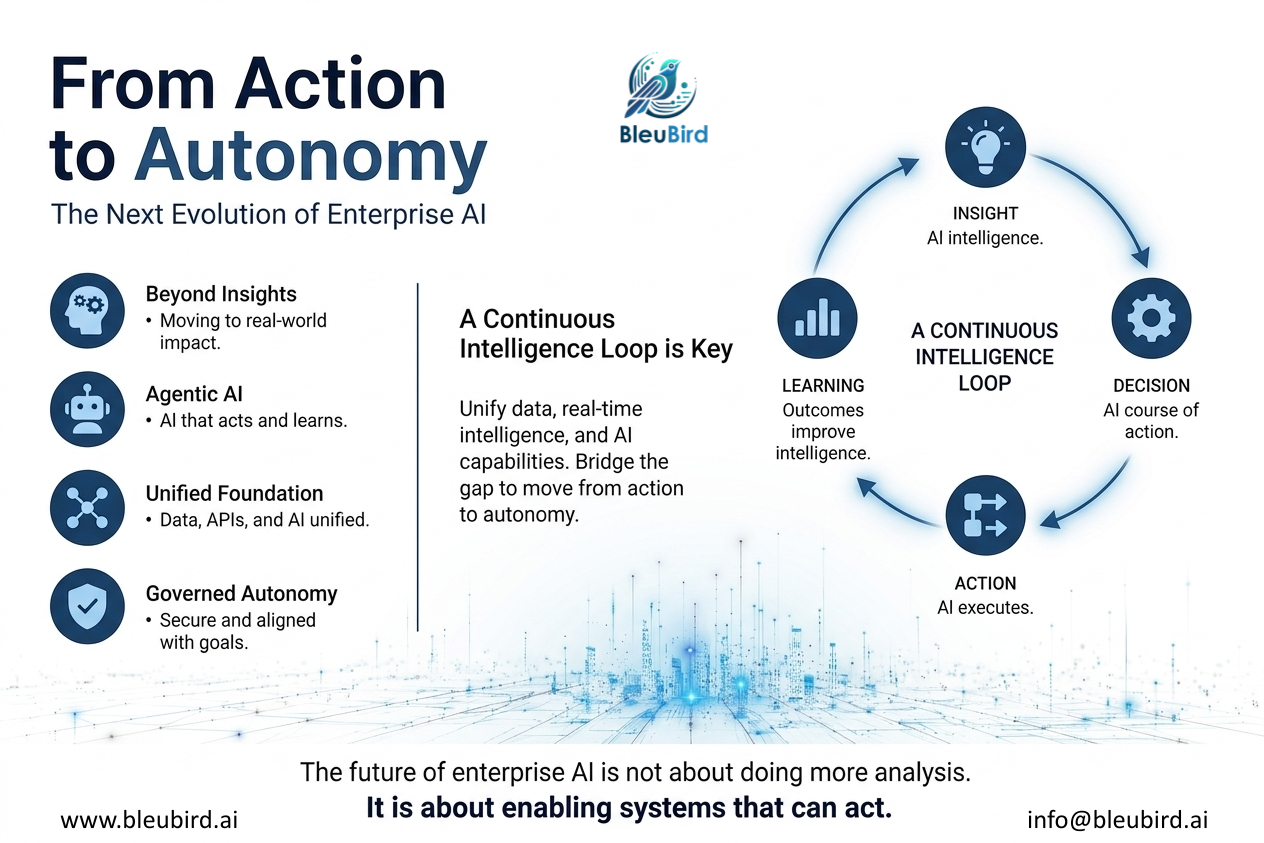
The most successful organizations are building around a continuous cycle:
Insight → Decision → Action → Learning
As this loop becomes increasingly automated, businesses become more responsive, adaptive, and efficient.
AI stops being a tool that employees use occasionally. It becomes part of how the business operates every day.
Closing
The future of enterprise AI is not simply about generating intelligence. It is about operationalizing it. Organizations that can connect data, decisions, and actions in real time will be best positioned to unlock the full value of AI. The next era of AI is not about doing more analysis. It is about enabling systems that can act.